Charting how early season fixture congestion shapes squad selection choices in Champions League group stages and linked domestic fixtures
Vera Vogel · Nov 6, 2026
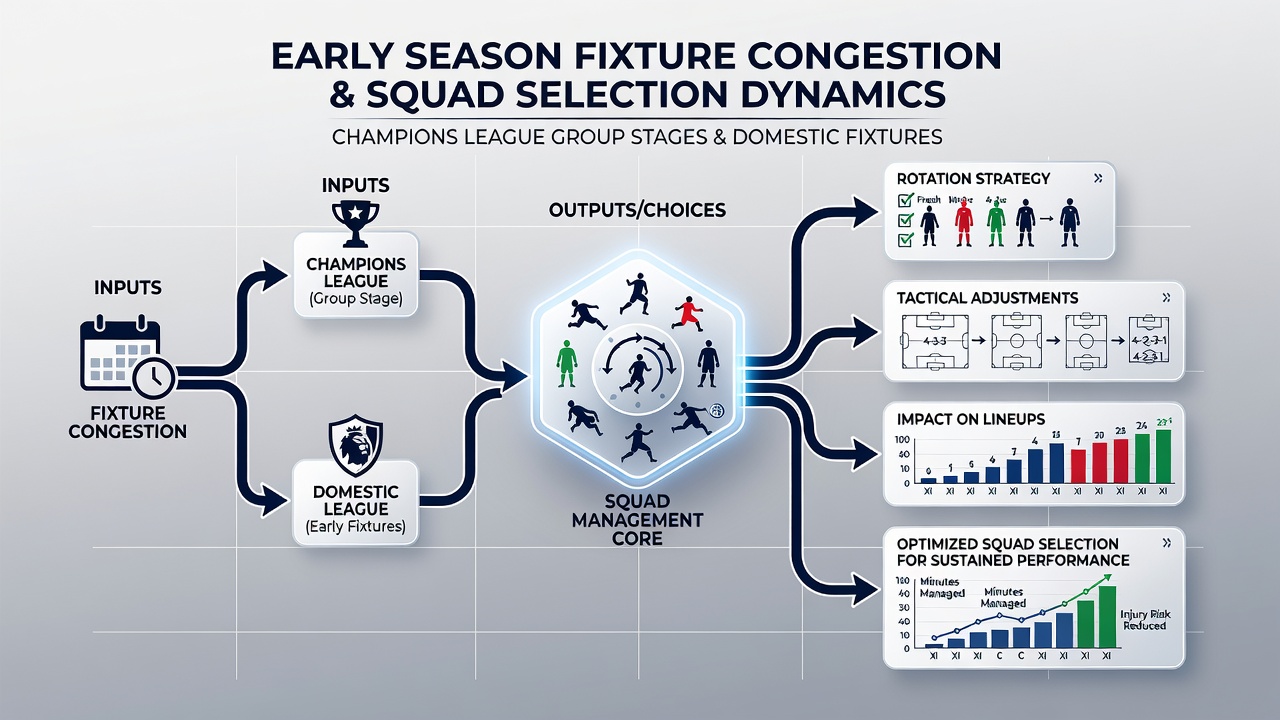
Charting how early season fixture congestion shapes squad selection choices in Champions League group stages and linked domestic fixtures
Early season schedules pack multiple domestic league matches alongside Champions League group stage openers, forcing clubs across Europe's top divisions to adjust player availability and rotation patterns. Data from the 2026 campaign shows teams in England, Spain, Germany and Italy often face three fixtures within eight days by late September, with additional continental travel layered on top. Observers note that these overlaps prompt managers to prioritize recovery metrics and positional depth when naming lineups for both competition types.
Fixture Overlaps in September and October Windows
Champions League groups typically begin in mid-September and run through November, which coincides with domestic calendars that already include weekend league games plus midweek cup ties in several countries. UEFA records indicate that 32 group stage participants each season encounter at least four such overlaps before the November international break, while clubs from the Premier League and Bundesliga experience teh highest density because their domestic cups start earlier than those in Ligue 1. Researchers tracking GPS data across 2025 and 2026 seasons found average player workloads rise by 18 percent during these blocks compared with later months when European schedules thin out.
Squad Selection Adjustments for Group Stage Matches
Coaches respond by deploying different starting elevens for home versus away Champions League fixtures, often resting key midfielders who logged heavy minutes in preceding league games. Figures released by the European Club Association reveal that teams finishing first or second in their groups during the 2024-25 cycle rotated an average of 3.2 players per match when the prior domestic fixture occurred within 72 hours. Squad lists submitted to UEFA must include at least 16 outfield players plus goalkeepers, yet actual selections hinge on medical reports and travel recovery times rather than fixed hierarchies. In November 2026, for instance, several clubs advanced from groups while using fewer than seven players across all six matches, illustrating how early congestion influences long-term availability planning.
Knock-on Effects in Linked Domestic Fixtures
Domestic league results suffer measurable dips when clubs field weakened sides after midweek European trips. Studies compiled by the German Sport University Cologne examined 120 Bundesliga matches played within four days of a Champions League group fixture between 2023 and 2026, showing a 0.4 goal per game reduction in scoring output for teams that traveled more than 800 kilometers. Similar patterns appear in La Liga data, where away domestic results following continental matches drop by 12 percent in points per game during September and October windows. Managers therefore weigh these downstream consequences when deciding whether to rest players for the Champions League opener or save them for the subsequent league encounter.
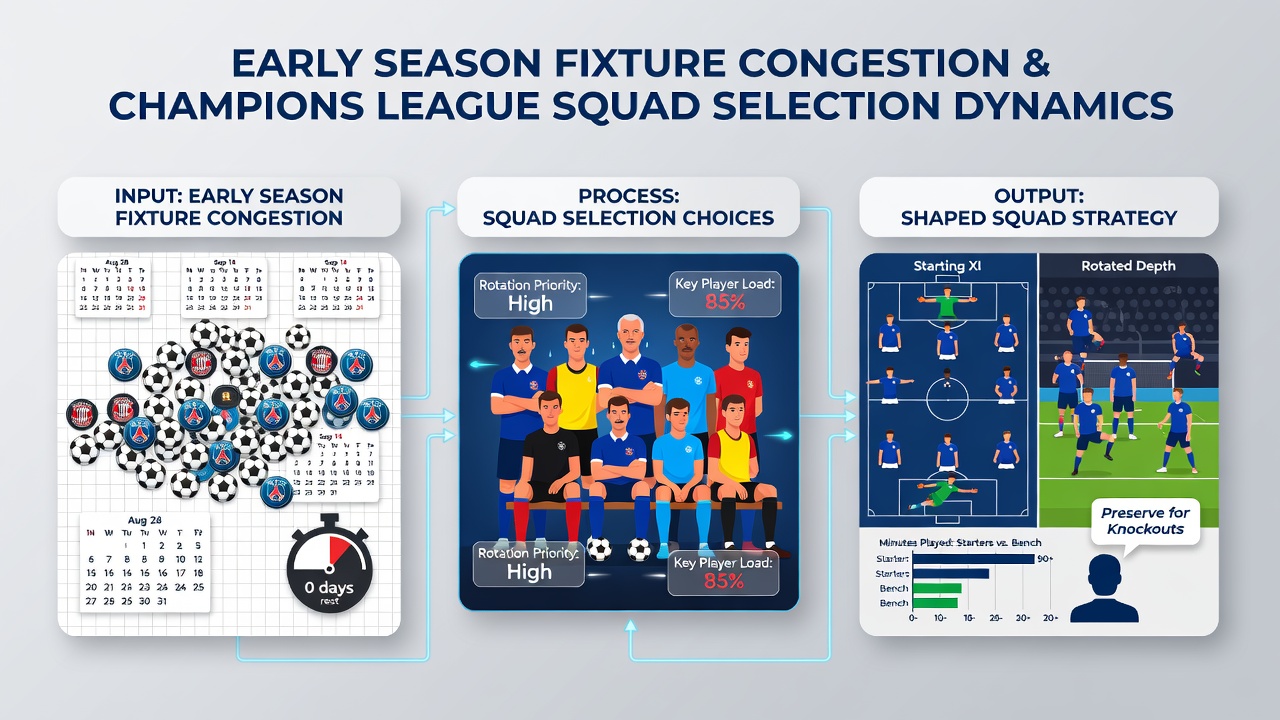
Role of Data and Medical Monitoring
Clubs increasingly rely on wearable technology and load management software to quantify fatigue across multiple competitions. A 2025 report issued by the Australian Institute of Sport documented how elite European academies integrate heart-rate variability readings and neuromuscular testing into selection meetings, enabling coaches to identify players at elevated injury risk before congested periods intensify. These tools allow objective comparisons between candidates for rotation, shifting decisions away from reputation alone toward measurable recovery timelines. In practice, squads that maintain detailed databases of prior workload patterns achieve higher availability rates through December, according to internal benchmarks shared among member clubs of the European Club Association.
Examples from Recent Seasons
One mid-table side in Serie A during the 2025-26 campaign rotated its entire defensive line for a midweek Champions League trip to Eastern Europe, then reinstated the regular back four for the following Sunday league match and secured a clean sheet. Another club from the Eredivisie tracked cumulative sprint distances across its first five fixtures and opted to start academy graduates in domestic games after European nights, preserving senior players for continental return legs. These approaches demonstrate how early congestion forces proactive rather than reactive squad management, with patterns repeating across multiple leagues each autumn.
Conclusion
Fixture congestion in the opening months channels squad selection toward evidence-based rotation and recovery prioritization, shaping outcomes in both Champions League groups and concurrent domestic fixtures through November 2026 and beyond. Data sets from multiple competitions continue to map these interactions, giving clubs clearer frameworks for balancing short-term results against season-long player availability.